hihi - stitchbird
With only around 2000 hihi in the world, why not come and get a glimpse at one of our rarest birds?
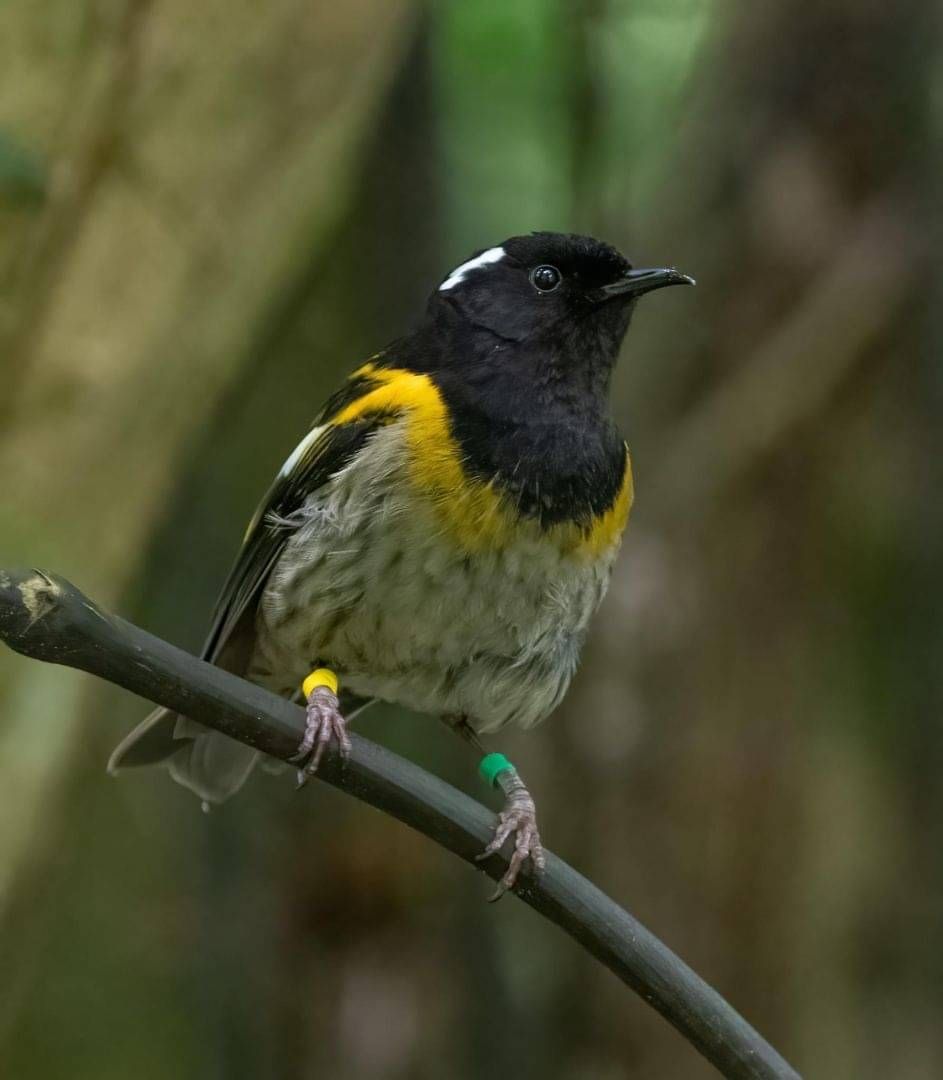
Photo: Geoff Shepherd

hihi - stitchbird
Notiomystis cincta

New Zealand Status: Endemic
Conservation Status: Nationally Vulnerable

Lifespan: Unknown
Size: 18cm (slightly bigger than a sparrow)
Weight: 30-36g

-Predation by introduced predators such as rats.
-Disease.
Is it a stitchbird?
Look for: For the boys, a black head with yellow neck and shoulder band. The white ear tufts look a bit like eyebrows. Females are a planer grey/brown apart from their white wing bars. Hihi also perch with their tail cocked up.
Listen for: The sound you'll most likely hear is a super high pitched call from the males made up of two or three notes. Males and females have a single note call that sounds a bit like titch.
Did you know?
- The only remnant population of hihi is on Little Barrier Island/Te Hauturu-o-Toi. They have now been translocated to multiple other sites to establish new populations.
- Hihi are the only birds in the world who are known to be able to mate face to face!
- The only member of their family (Notiomystidae), hihi are more closely related to tieke/saddleback and kokako than they are to tui and korimako/bellbird, their fellow nectar feeders.
Hihi @ Sanctuary Mountain Maungatautari
Between 2009 and 2011, 155 individuals were translocated to Maungatautari from Tiritiri Matangi Island and Little Barrier Island.
Hihi feed on invertebrates, fruit and nectar. All sites that have had hihi translocated also have supplementary feeding stations. If you are heading towards the tower on the Rata Track you will pass one of these on your left. There is another on the Nikau Track as you turn left after the tower and a third also on the Nikau Track just after the junction with the Rimu Track.