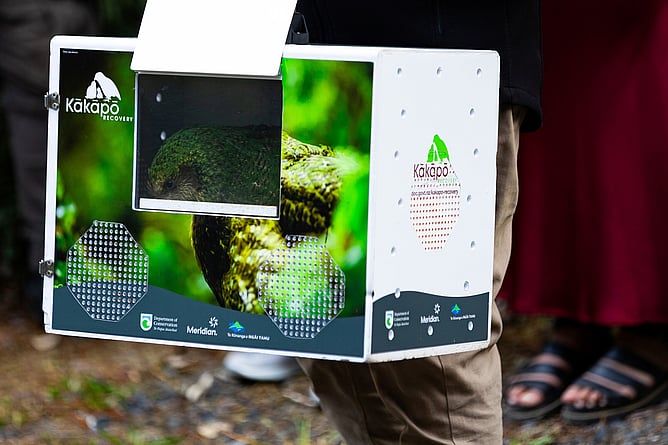
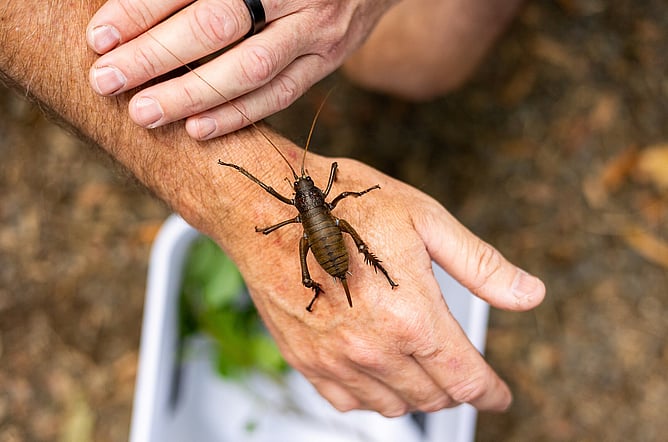
Two additional kākāpō and a new cohort of 122 Mahoenui giant wētā have arrived at Sanctuary Mountain Maungatautari, marking another significant conservation milestone as the sanctuary celebrates 25 years of ecological restoration.
These arrivals are a living reminder of the extraordinary transformation made possible through 25 years of community dedication to protecting and restoring Maungatautari. A once audacious vision to enclose an entire mountain, remove introduced predators and pests, and return a precious ancient forest to health has grown into the world's largest pest-proof fenced ecosanctuary.
Following another successful breeding season that saw the national kākāpō population reach 325 birds, two additional juvenile males have now joined the pioneering mainland habitat trial at Sanctuary Mountain Maungatautari.
At the same time, a new cohort of 122 Mahoenui giant wētā from the Department of Conservation Recovery Programme and Ōtorohanga Kiwi House breeding programme are being released to strengthen an established population on Maungatautari.
The species arrivals highlight Sanctuary Mountain Maungatautari's ongoing role in the recovery of some of Aotearoa New Zealand's most threatened wildlife and demonstrate the extraordinary progress made since restoration efforts began.
Today, the sanctuary protects 3,363 hectares of native forest behind a 47-kilometre pest- and predator-proof fence and safeguards more than 730 native species, including the 15 native species returned to Maungatautari through iwi-to-iwi tono tikanga. It is also leading the way on conservation funding, launching Nature Credits last year to help fund its ongoing operational overheads, making translocations like these possible.
Chief Executive Helen Hughes says the 25-year milestone is an opportunity to reflect on both the achievements of the past and the opportunities still ahead.
“Twenty-five years ago, few people would have imagined wildlife like kākāpō, takahē, kōkako and Mahoenui giant wētā thriving on Maungatautari. Today, they are here because thousands of people chose to back an ambitious vision and never gave up on it.”
“We're extremely grateful to the many partners who continue to make these important translocations possible. From our mana whenua and iwi partners to DOC, recovery and breeding programmes, staff, volunteers and supporters, all play a critical role in helping threatened species recover and thrive. The arrival of these new kākāpō and Mahoenui giant wētā taonga is a reminder that this is not a finished story. It's continuing to evolve, and we're excited about what comes next.”
The kākāpō habitat trial, delivered in partnership with the Department of Conservation's Kākāpō Recovery Programme, Te Rūnanga o Ngāi Tahu and mana whenua, remains an important part of efforts to secure the future of one of the world's rarest parrots.
As part of the next phase of the trial, the birds have joined the three resident kākāpō already living on Maungatautari. Their arrival reflects confidence in the programme and ongoing improvements in monitoring technology.
DOC Acting Operations Manager for kākāpō Annie Wallace says the transfer of two juvenile kākāpō to Sanctuary Mountain Maungatautari is a continuation of the fenced habitat trial that began in 2023.
“The two males joining today will join the three who have lived at the site since 2023, helping build our understanding of how kākāpō use fenced mainland habitat. One of the most significant challenges facing Kākāpō Recovery is finding suitable predator-free habitat for a growing population.”
“Introducing the juveniles at this stage provides an opportunity to learn how young kākāpō establish their first home ranges in a fenced mainland environment.”
Ngāi Tahu representative on the Kākāpō Recovery Group Tāne Davis says Ngāi Tahu feel a strong sense of responsibility towards the kākāpō as a taonga.
“With the urgent need to find new homes for the manu, it is important that we continue to try new things working alongside our mana whenua partners.”
“Introducing the two juvenile kākāpō into the sanctuary to see how they adapt on the mainland is another step in our ongoing learning about the manu and a very fitting way to acknowledge the achievements of the sanctuary over the past 25 years.”
The success of the Mahoenui giant wētā breeding programme at Ōtorohanga Kiwi House, in partnership with Te Whare ki Mōkau ki Runga, Ngāti Maniapoto, mana whenua and DOC, has enabled the release of another 122 Mahoenui giant wētā onto Maungatautari just 14 months after the last significant translocation of 192 individuals in August 2025.
The new cohort joins the established population on Maungatautari, building on previous releases and contributing to the long-term recovery of one of Aotearoa's most distinctive and threatened invertebrates.
Ōtorohanga Kiwi House's Marketing Manager, Tyler Lloyd, says:
“Behind every wētā released is the care, patience and dedication of our team at Ōtorohanga Kiwi House, who have nurtured these taonga through each stage of their lives. So much of that work happens quietly behind the scenes, and this release is a special opportunity to recognise the people whose commitment has helped make it possible.”
“It is a real honour to have bred and raised these remarkable animals. Seeing them take their place in the forest at Maungatautari is an incredibly rewarding moment for everyone who has cared for them. It is the moment that patient, daily work becomes part of something much bigger.”
“No single organisation can achieve that alone. This release brings together the knowledge, commitment and hard work of Ngāti Maniapoto, DOC, Sanctuary Mountain Maungatautari and our own team. It is deeply rewarding to see those shared efforts give these remarkable wētā the chance to establish future generations. Our hope is that, long into the future, these taonga will be an enduring part of the forest, and releases like this will be remembered as the steps that helped make that possible.”
These milestone translocations come as Sanctuary Mountain Maungatautari brings together mana whenua, landowners, volunteers, supporters, partners and the wider community for its Annual General Meeting and 25-year celebration event.
The occasion reflects on a quarter-century of collective achievement while also looking ahead to the future through the sanctuary's emerging 1,000-Year Plan with a focus on intergenerational protection and restoration.
Ngāti Koroki Kahukura alongside Ngāti Hauā, Raukawa and Waikato, maintain deep and enduring connections with Maungatautari as a treasured tūpuna and guide the sanctuary's direction.
Sanctuary Mountain Maungatautari Co-Chair and Ngāti Koroki Kahukura representative Norma Taute says the anniversary is a celebration of what can be achieved when a community comes together.
“Twenty-five years ago, restoring an entire mountain ecosystem seemed impossible. Today, Maungatautari stands as proof of what can be achieved when mana whenua, landowners, scientists, volunteers, staff, funders and community supporters come together around a common purpose and shared vision.”
“For mana whenua, Maungatautari is a tūpuna. The restoration of this maunga has always been about restoring the health and mauri of the maunga, strengthening our connection to place, honouring our responsibilities as kaitiaki and working together through kotahitanga. Today, the maunga sings again because people chose to share the dream, and that is something we can all be proud of.”
Hughes agrees that people have always been at the heart of Sanctuary Mountain Maungatautari.
“Celebrating 25 years is about recognising how far we've come and acknowledging all the countless people who have contributed to making it happen. It has been, and continues to be, a journey of innovation and determination, and while at times very challenging, it is incredibly inspiring. Without question it is the relentless passion and commitment of the community of supporters who have enabled us to get to where we are today.”
“The arrival of these new kākāpō and Mahoenui giant wētā speaks to the positive progress we are making here and across Aotearoa, and we look ahead with purpose to the next 25 years, 1,000 years and beyond.”
- ENDS-
Further information on arriving kākāpō:
The juveniles are from this year’s record-breaking breeding season that produced 90 kākāpō chicks taking the population to a recovery-era high of 325.
Awarua A2 was the last chick to fledge on Whenua Hou and one of only a few wild reared chicks to figure out how to use a hopper.
Tiwhiri A4 hatched on Anchor and later went to Dunedin Wildlife Hospital for a leg injury and then onto Whenua Hou, he was always quite shy & reserved.