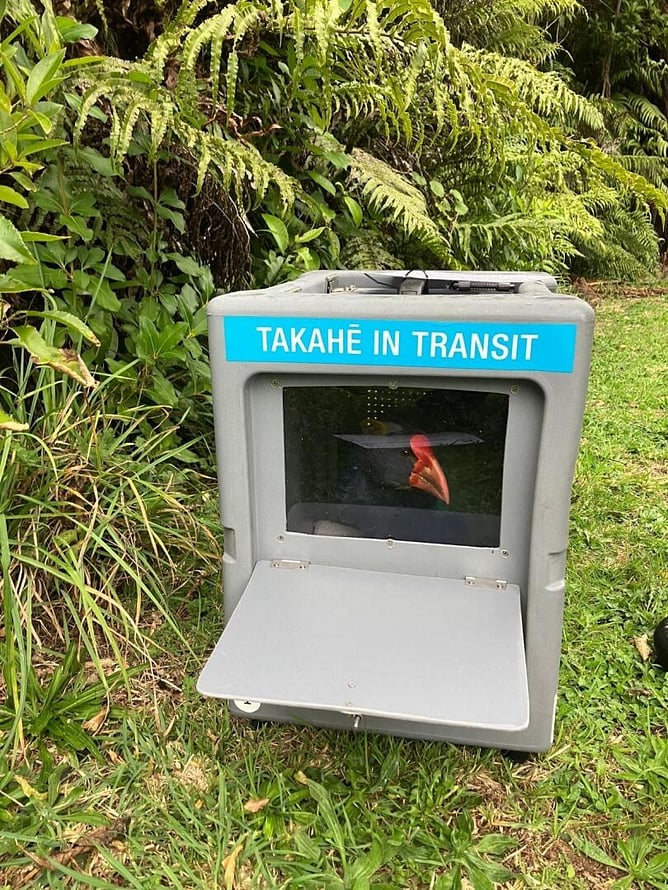
This year has been a busy season for takahē breeding. We have had two families of four over the breeding season and sadly had to wave goodbye to our yearling female "Puanga" this year on the 16th April as she was due to join the new wild population in the Rees Valley. Her little brother (yet to be named) will miss her the most, as Puanga largely played the role of Mum this year, feeding the little one regularly when he was growing up in the Tautari Wetland. She did such a great job that parents Hemi and Nancy attempted to re-nest but sadly the eggs were not fertile. Yearling helpers learn their skills for chick-raising by helping out the parents, so we think Puanga is going to make a great Mum! She was released into the Rees Valley in the South Island and is able to be monitored by radiotracking and we hope to hear how she is doing soon.
Our second breeding pair, Pirie and Puiaki also successfully hatched two chicks this year and recent sexing results shows they are both females. The three chicks will reside with us a little longer and recently had their full health checks, vaccinations and shiny new bangles (leg bands) applied by Auckland Zoo bird staff who come out each year to help us with the banding and health checks.
Update from the DOC Takahē Recovery Team
We're continuing to expand the population of takahē in the Rees Valley, with the release of another 33 manu in April (including Puanga). The new arrivals join the initial 18 takahē that were released at the new wild site in February. This means the Rees Valley is now our second largest wild site, after Fiordland's Murchison Mountains.
As the Shelter Rock Hut visitor book shows, you now have a good chance of seeing this previously thought extinct species in the wild! Returning takahē to whenua [land] they likely inhabited centuries ago, and to the tāngata [people] takes teamwork. We achieve this mahi with Te Rūnanga o Ngāi Tahu and Southern Lakes Sanctuary alongside our National Partner Fulton Hogan and the New Zealand Nature Fund.
The Rees Valley population is made up of manu from our base at Burwood Takahē Centre near Te Anau as well as sanctuaries around the country that were transported south by Air New Zealand through the Department of Conservation national partnership. We will continue to monitor how the population adapt over winter and aim to have another cohort join them at this promising new site later this year.
Despite ongoing challenges at the nearby Greenstone Valley site due to stoat predation, our wild populations are all increasing, or stable. With all sanctuary sites operating at capacity and the population growing every year, mahi to establish these large wild sites is crucial to the recovery of this taonga species.