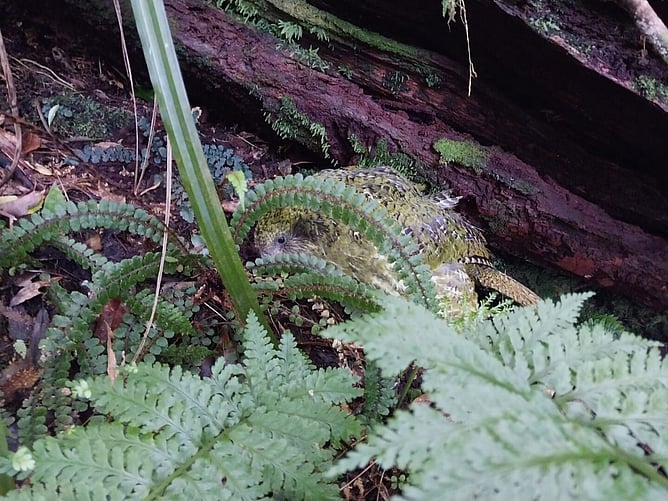
This is 10-year-old kākāpō Taeatanga, found in good condition after recently taking an unplanned break from technology. Last month, as he continued with his nightly nocturnal activities, he was oblivious to the fuss he caused when our team of biodiversity rangers were unable to track him due to a failed transmitter.
The three kākāpō currently residing on Maungatautari are monitored closely. Positions are routinely checked three times a week, and GPS logs may be received daily from birds wearing remote download GPS. Last month, rangers noticed Bunker and Tautahi had been checking-in on the monitoring network as usual, however Taeatanga hadn't been detected for a few days. This seemed unusual as Taeatanga had remained within a home range since March, when supplementary feeding opportunities were set up for him in the area.
After 10 days of extensive searching for Taeatanga (both inside and outside the sanctuary), and setting up additional trail cameras, a kākāpō was spotted on camera footage near the known home range of Taeatanga. A plan to catch the elusive, nocturnal manu (bird) was soon in place.
Rangers spent several days watching the cameras for any regular movements or routines before setting up a lure of food nearby a likely hotspot. Then, it was time for our rangers to carry out a nighttime stakeout.
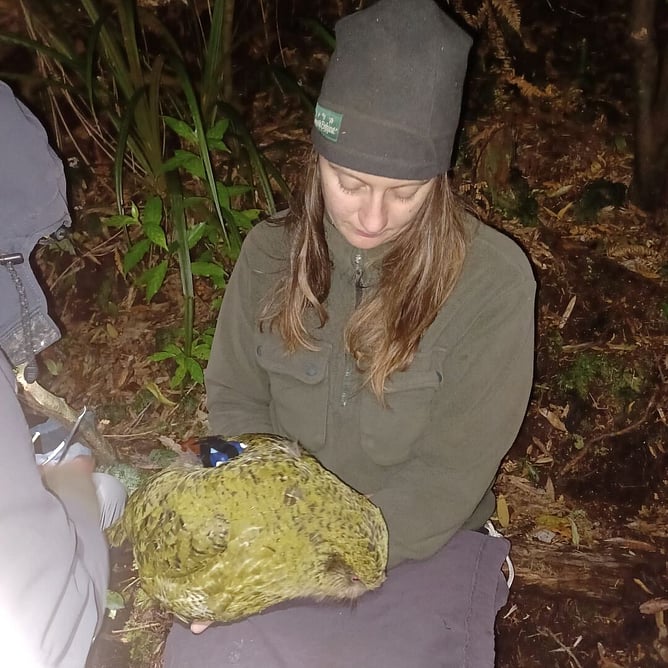
It wasn't long after dark when the kākāpō turned up, was carefully caught, and confirmed to be Taeatanga. He was in great condition and still wearing his transmitter, however the technology had failed. This had left him undetectable by the monitoring network and radio telemetry. Our rangers fitted a new transmitter, and we're pleased to say Taeatanga is now officially back on our radar after 15 days. He has been checking in daily with the remote monitoring system since his new transmitter was attached and has remained in his usual hangout spots.
Up to five percent of kākāpō transmitters fail each year. It can take some time, however these birds can usually be found using prior knowledge and data to search likely locations, the lure of food, or through the assistance of specially trained conservation dogs.
It's a complex job for DOC's Kākāpō Recovery Team, managing all 244 kākāpō alive today, yet necessary while we work together to restore the mauri of this taonga species.
The ranger team at Sanctuary Mountain Maungatautari achieved a great result through dedicated search efforts for Taeatanga. During this challenging period the team at Sanctuary Mountain Maungatautari were incredibly grateful for the support and expertise shared by DOC's Kākāpō Recovery Team.
The positions of all three birds at Maungatautari continue to be checked three times a week and their activity is monitored closely.
In just 18 months, the habitat trial for kākāpō at Sanctuary Mountain Maungatautari has continued to provide crucial learnings, but it could be years yet until we know enough about the site and the part it could play in the future recovery of this taonga (treasured) species. This work is achieved alongside Ngāti Koroki Kahukura, Ngāti Hauā, Raukawa and Waikato, the Kākāpō Recovery Team, their Treaty Partner Ngāi Tahu, and National Partner Meridian Energy.
Photo: Sanctuary Mountain Maungatautari Ranger Tori holds Taeatanga while a new transmitter is fitted.
Photo credit: Ranger Craig Montgomerie