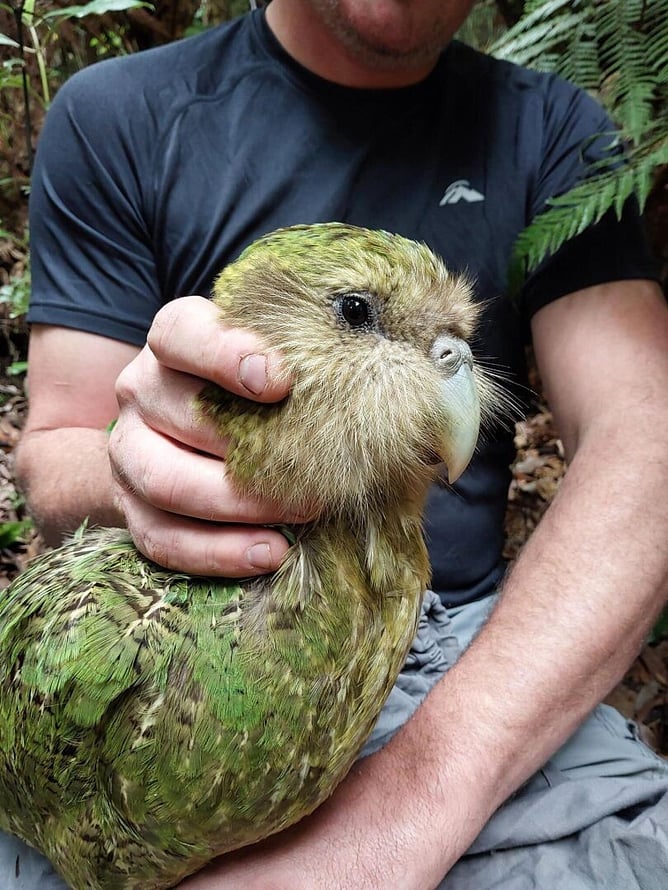
Over the last year, a small number of male kākāpō have been helping us, and the Kākāpō Recovery Team to learn whether a larger population could one day thrive in a fenced sanctuary on mainland Aotearoa.
This is the latest update on the mainland kākāpō residing at Maungatautari:
The last couple of months at the sanctuary have focused on climbing trials. It might sound like a new Olympic sport, but the purpose of these trials was to determine how kākāpō have been managing to depart our pest-proof fence, despite the barrier that was installed to prevent this.
The trial:
A pen was set up with one side replicating the 2m high perimeter fence, complete with overhanding vegetation and other climbing opportunities. One at a time, three kākāpō each took turns in the pen after dark, with two observers and infra-red cameras watching on.
Fair play to the feathered athletes, the results provided us with some golden insights into kākāpō behaviour. Over five nights each, both repeat escapees, Tautahi and Otepoti, made multiple escapes. Bunker (who has never escaped the sanctuary) showcased his climbing abilities but didn't leave the pen.
The climbing trials confirmed the birds are not climbing the fence itself, however, they likely use overhanging vegetation that moves with their body weight to get over it. We also saw that kākāpō have good memory for previous escape options. The results will be used to help target areas that need the most attention as part of ongoing vegetation clearance work around the sanctuary.
Following the trials, Otepoti was returned to the southern islands. Supplementary feeding the remaining birds, Bunker, Tautahi, and Taeatanga, seems to have helped lure them inland for now. This is a short-term measure until they settle into longer-term home ranges. Until such time, no further birds will be added to the trial.
Work is also ongoing looking into improved GPS tag technology to support the monitoring of these birds that continue to support learnings that are crucial to the future of their species.
This work is achieved alongside the Department of Conservation's Kākāpō Recovery Team, Ngāi Tahu, and Ngāti Koroki Kahukura.
Delve deeper into the stories of the last 12 months with these news items: